The season of lamps
Deepavali lights the first lamps of the season, and Karthigai Deepam sets them on every doorstep. Between the two come the thirunakshatrams of Manavala Mamunigal, Pillai Lokacharya and Poigai Alwar, and then, on one day, Thirumangai Alwar and Nampillai, with Thiruppan Alwar the next. This issue follows the lamp from hand to hand: from the Alwars, through the acharyas, to the lamp you light at your own door.
- 1Aippasi and Karthigai at a glance, day by day
- 2One idea, simply: the acharya, one lamp lighting another
- 3Thirumangai Alwar and Thiruppan Alwar, and three acharyas of the season
- 4Pasuram of the month: the first verse of Periya Tirumozhi
- 5Divya Desam: Thiruvali-Thirunagari, where Neelan met the Lord
- 6Readers ask
- 7Young seekers: the singer the Lord sent for, a petal kolam, a quiz
- 8At home: the Karthigai lamps and pori urundai
- 9From our shelf
Aippasi and Karthigai, day by day
Forty-five days from the vyloka.in calendar: Deepavali, the thirunakshatrams of three Alwars and three acharyas, Karthigai Deepam, and the start of the Adhyayana Utsavam on 10 December.
- Rama Ekadasi
- Dwadasi parana 6:08 AM – 8:28 AM
- Deepavali (Naraka Chaturdasi)
- Amavasai · Pitru tarpanam
- Manavala Mamunigal Thirunakshatram
- Senai Mudaliar (Vishvaksena) Thirunakshatram
- Poigai Alwar Thirunakshatram
- Pillai Lokacharya Thirunakshatram
- Thiruvonam (Shravana) vratam
- Karthigai begins
- Prabodhini Ekadasi
- Dwadasi parana 6:14 AM – 8:33 AM
- Karthigai Deepam
- Thirumangai Alwar Thirunakshatram
- Nampillai Thirunakshatram
- Pournami
- Vishnu Deepam (Perumal Karthigai)
- Thiruppan Alwar Thirunakshatram
- Utpanna Ekadasi
- Dwadasi parana 6:20 AM – 8:38 AM
- Amavasai · Pitru tarpanam
- Adhyayana Utsavam begins · Pagal Pathu
- Thiruvonam (Shravana) vratam
The acharya: one lamp lighting another
Why the sampradaya keeps the thirunakshatrams of its teachers as carefully as its festivals.
In our Navaratri issue we met Thayar, who speaks to the Lord for us. Here on earth the acharya does the same loving work. He takes our hand, gives us the Lord's name and the holy mantras, teaches us what the Alwars meant, and walks with us until we reach Him. An old verse explains the word guru itself: gu is darkness, and ru is the one who removes it.
The tradition tells a story that shows how much this matters. At Srirangam, Namperumal asked Manavala Mamunigal to explain Tiruvaymozhi in His presence, and for a whole year the Lord sat and listened. On the last day a small child stepped out of the gathering, joined his palms before Mamunigal, recited a new taniyan in his praise, and was gone. Everyone understood that the child was Namperumal Himself, taking Mamunigal as His own acharya. That taniyan is printed at the foot of this issue.
If the Lord Himself chose an acharya, how much more do we need one.
That is why the thirunakshatrams of Mamunigal, Pillai Lokacharya and Nampillai fall in this issue alongside Deepavali and Karthigai Deepam, and why they are kept with the same care. On an acharya's day, recite his taniyan, read a few lines of what he gave us, and remember with gratitude the one who first put the lamp in your hand.
From the highway to the sanctum
Two Alwars of Karthigai: a chieftain who robbed to feed devotees, and a singer who would not cross the river.
According to tradition, Thirumangai Alwar was born at Thirukkuraiyalur near Sirkazhi and named Neelan. A brave warrior, he led the Chola king's army and was given the region of Thirumangai to rule. He wished to marry Kumudavalli, who would accept only a devotee of the Lord. At her word he received the pancha samskaram and promised to feed a thousand and eight Sri Vaishnavas every day. When his wealth ran out, he took to waylaying the rich to keep that promise.
Near Thiruvali-Thirunagari, the Lord and Thayar came by as a wedding party. Neelan seized their jewels but could not lift the bundle, and when he demanded the secret of the bridegroom's power, the Lord gave him the Thirumantram. His life changed in that moment, and, according to tradition, the first thing he sang was the name he had been given.
From then on he went from kshetram to kshetram and sang of about eighty-six Divya Desams, more than any other Alwar. His six works are honoured as the six limbs of Nammalwar's four Tamil Vedas. According to tradition he also began the festival of reciting Tiruvaymozhi before Sri Ranganatha that grew into the Adhyayana Utsavam, which begins this year on Thursday 10 December.
The next day is Thiruppan Alwar's. Raised among the panars, the singers of Uraiyur, he stood on the far bank of the Kaveri and sang to Sri Ranganatha every day, until the Lord sent a sage to carry him into the sanctum. There he sang ten verses, Amalanadipiran, from the Lord's holy feet to His face. Earlier in the season, on 16 November, comes Poigai Alwar, who lit the first lamp of the Divya Prabandham at Thirukkovalur.
The Lord came to the highway to meet a thief, and sent a sage to fetch a singer.
Mamunigal, Pillai Lokacharya and Nampillai
Manavala Mamunigal (Aippasi Thirumoolam, Friday 13 November) gave his life to Srirangam, and Namperumal took him as His own acharya. Pillai Lokacharya (Aippasi Thiruvonam, Monday 16 November, the same day as Poigai Alwar) set out the teaching on surrender in eighteen clear works, and gave his last years to protecting Namperumal. Nampillai (Karthigai Karthigai, Tuesday 24 November) shares his day with Thirumangai Alwar, whom he loved so dearly that he was called Kalivairi Dasar. His lectures on Tiruvaymozhi at Srirangam were written down as the Eedu.
I have found the name
According to tradition, the first verse Thirumangai Alwar sang after the Lord gave him the Thirumantram.
Read it slowly and listen to the pairs: he withered, he joined, he ran, he searched, each word said twice, as a tired man tells the story of his wandering. The last line holds what he found at the end of it all: the name Narayana.
All ten verses of this first decad end with the same words, as if he cannot stop saying the name now that he has it. A simple way to keep his thirunakshatram is to read the ten together, or to say this first one with your family at the evening lamp.
Thiruvali-Thirunagari, where Neelan met the Lord
One Divya Desam in two temples, and the ground where a chieftain became an Alwar.
Thiruvali-Thirunagari is counted as one Divya Desam, though it is two temples a few kilometres apart: Lakshmi Narasimhan at Thiruvali, and Vayalali Manavalan at Thirunagari. Thayar is Amruthagadavalli.
This is Thirumangai Alwar's own country. According to tradition it was near here that the Lord and Thayar came by as a wedding party, and here that Neelan received the Thirumantram from the Lord Himself. The sampradaya remembers this ground as the place where his life turned.
His journey ended far to the south, at Thirukkurungudi, where, according to tradition, he attained the Lord's feet. A pilgrim who visits both keeps the beginning and the end of the last Alwar's life.
Readers ask
Questions families often ask in Aippasi and Karthigai.
Deepavali remembers Sri Krishna's victory over Narakasura. Many homes rise before dawn on Naraka Chaturdasi for the oil bath, offer the new clothes and sweets to Perumal before anyone wears or eats them, and light lamps in the evening. This year Naraka Chaturdasi falls on Sunday 8 November by our Srirangam reckoning. How your own home keeps the day is a question for your elders and your acharya.
Karthigai Deepam falls on the Karthigai star in the month of Karthigai, on Tuesday 24 November this year. Many Sri Vaishnava homes and temples light their lamps on the next day, Vishnu Deepam, also called Perumal Karthigai, on Wednesday 25 November, and some families light them on both days. Keep your family's custom; if you are not sure, ask your elders or your acharya.
The singer the Lord sent for
Long ago, at Uraiyur near Srirangam, a baby was found in a paddy field and raised by a family of singers. He grew up singing to Sri Ranganatha every day, standing on the far bank of the Kaveri river. Because of the family he was raised in, he would not cross the river into Srirangam.
One morning a sage came to the river to fetch water for the Lord and asked him to step aside. The singer, lost in his song, did not hear, and the sage threw a stone that cut his forehead. When the sage reached the temple, he saw blood on the Lord's own forehead, and the Lord told him to go and carry the singer into the temple on his shoulders.
So Thiruppan Alwar came before Sri Ranganatha riding on the sage's shoulders, and sang ten verses about the Lord, from His feet up to His face. The Lord does not look at where we were born. He looks at love, and He comes to fetch His devotee Himself.
Karthigai quiz
- Who carried Thiruppan Alwar into the temple?
- How many verses are there in Amalanadipiran?
- What did Thirumangai Alwar say he had found?
- Which Alwar sang of the most Divya Desams?
- Which acharya did Namperumal take as His own acharya?
Show the answers
- The sage Loka Saranga Muni
- Ten
- The name Narayana
- Thirumangai Alwar
- Manavala Mamunigal
Make five rows of five dots. Draw a petal round each dot so that the petals meet corner to corner, then a smaller petal inside each one, and close it with a square. For Karthigai Deepam, set a small lamp at each corner of the square.
The Karthigai lamps and pori urundai
A simple Karthigai evening
- In the afternoon, clean the lamps and the doorstep, and draw a kolam.
- At dusk, light the clay lamps at the door, on the windowsills and before Perumal and Thayar.
- Sing a few verses together: Thirumangai Alwar's first decad, or Thiruppan Alwar's Amalanadipiran.
- Offer pori urundai as naivedyam and share it with neighbours and with children who come to see the lamps.
Pori, puffed rice, bound with jaggery into small balls, is the Karthigai offering in many homes. Ask an adult to handle the hot syrup.
- 4 cups puffed rice (nel pori or aval pori)
- 1 cup grated jaggery
- ¼ cup water
- ¼ tsp cardamom powder
- 1 tbsp ghee
- 2 tbsp thin pieces of fresh coconut, fried in a little ghee (optional)
- A little dry ginger powder (optional)
- A little rice flour or water for your hands
- Sift the puffed rice and pick out any husks, and keep it in a wide bowl.
- Melt the jaggery in the water, strain it, and boil until a drop placed in cold water can be gathered into a firm ball.
- Turn off the heat and stir in the cardamom, ghee, coconut and dry ginger.
- Pour the syrup over the puffed rice and mix quickly with a ladle.
- While it is still warm, dust your hands with rice flour or wet them, and press small handfuls into balls.
- Lay a tulasi leaf on top before offering.
Many homes also make appam and vella adai for the evening.
One lamp lighting another
A teaching does not live on palm leaves; it lives in people, and Ramanuja knew this well. … Think of the lamps in a temple at dusk. The priest lights one lamp from the sanctum flame. From that lamp he lights the next, and from that one the next. Each new lamp burns with the same fire, and nothing is lost when a flame is shared. The line of Acharyas is like this: each teacher received the light from the one before and passed it on.
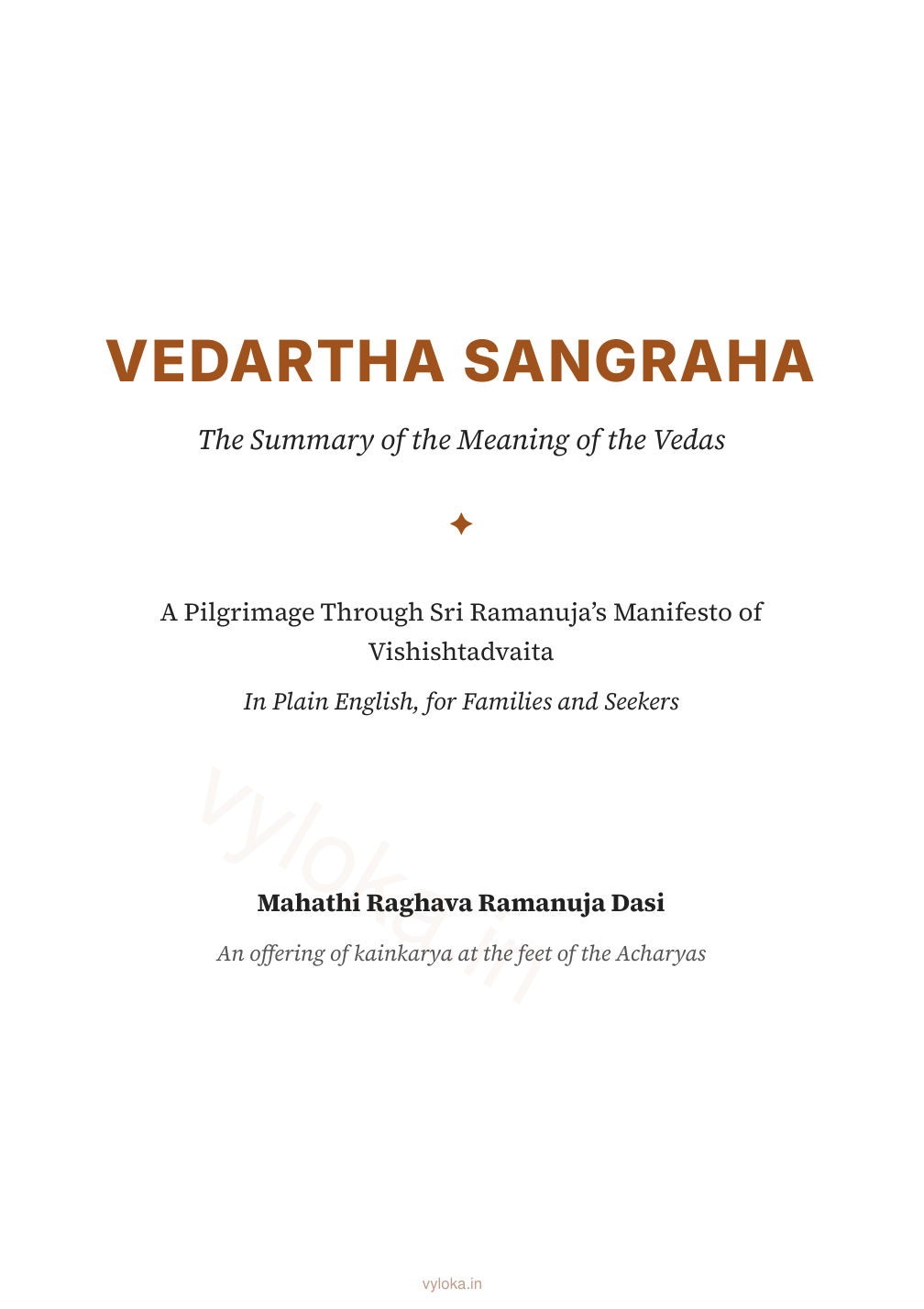
Mahathi Raghava Ramanuja Dasi, Vedartha Sangraha in plain English. Read the whole book online at vyloka.in.