The mother who speaks for us
In Sri Vaishnava temples the nine nights of Navaratri belong to Thayar. At Srirangam, Sri Ranganayaki receives devotees in her golu mandapam each evening, and at Tirumala the Navaratri Brahmotsavam runs to Vijayadasami. As the festival ends, the thirunakshatrams of the first three Alwars begin: the Alwars who lit the first lamps of the Divya Prabandham and, by their light, saw the Lord with Thayar.
- 1Navaratri at a glance, night by night
- 2One idea, simply: purushakaram, the mother who speaks for us
- 3The first three Alwars and the lamps of Thirukkovalur
- 4Pasuram of the month: the first verse of Moondram Tiruvandadi
- 5Divya Desam: Thirukkovalur, and Navaratri at Srirangam and Tirumala
- 6Readers ask
- 7Young seekers: a golu of the ten avatars, a lotus kolam, a quiz
- 8At home: the golu, the evening lamp and sundal
- 9From our shelf
Navaratri, night by night
The nine nights and the days that follow, with every observance from the vyloka.in calendar. This year Vijayadasami falls on Poigai Alwar's thirunakshatram.
- Navaratri begins
- Tirumala Navaratri Brahmotsavam begins
- Garuda Seva, Tirumala
- Purattasi Saturday
- Aippasi begins
- Saraswati Puja
- Vijayadasami
- Chakra Snanam, Tirumala
- Poigai Alwar Thirunakshatram
- Pillai Lokacharya Thirunakshatram
- Thiruvonam (Shravana) vratam
- Bhoothath Alwar Thirunakshatram
- Papankusha Ekadasi
- Pey Alwar Thirunakshatram
- Dwadasi parana 6:05 AM – 8:27 AM
Purushakaram: the mother who speaks for us
Why a Sri Vaishnava never goes to the Lord alone.
Think of a child who has broken something precious. It does not march up to its father holding the pieces. It finds its mother first, and she goes in with it, already speaking for it. The sampradaya calls this purushakaram: Piratti, our mother, stands between us and the Lord, softens His heart toward our faults and turns our hearts toward Him.
The Ramayana gives the classic example. Kakasura, the crow, harmed Sita herself, and Rama's arrow chased him through all the worlds until no one would shelter him. He fell at Rama's feet in Sita's presence, and he was spared: the one he had offended was the one who spoke for him. Ravana was offered the same help by Sita and refused it.
The Lord looks upon our record; the Mother looks upon our face.
She is not a separate means; she brings us to the One who is the means. That is why surrender in our sampradaya begins at her feet, and why Navaratri, kept for Thayar, is a festival of hope. Here on earth the acharya does the same loving work for us.
The three lamps of Thirukkovalur
The first three Alwars appeared on three days, one after another, and met on one rainy night.
According to tradition, Poigai Alwar appeared in a golden lotus in the temple pond at Thiruvekka in Kanchipuram. Bhoothath Alwar appeared the next day in a flower at Thirukkadalmallai, today's Mamallapuram, and Pey Alwar the day after in a red lily in a well at Mylapore. They are the Mudhal Alwars, the first Alwars.
On a dark, rainy night at Thirukkovalur, Poigai Alwar took shelter in the narrow front passage of a sage's hermitage, where there was room for one person to lie down. Bhoothath Alwar came and asked for shelter, and the two sat. Then Pey Alwar came, and the three stood side by side. Soon they felt a fourth pressing in among them in the dark. It was Perumal Himself, Trivikrama of Thirukkovalur, who could not stay away from His devotees.
To see who had come, Poigai Alwar lit a lamp and began to sing: a lamp made of the whole world. Bhoothath Alwar lit a second lamp, a lamp of love. By the light of the two lamps Pey Alwar saw the Lord, with Thayar, and sang of the joy of that sight. Their three works open the Iyarpa, the third thousand of the Divya Prabandham.
In this month of lamps it is worth remembering what Pey Alwar saw: not the Lord alone, but the Lord with Thayar. The sampradaya remembers these three as the ones who first lit the lamp by which every later Alwar and acharya found the way.
By the light of two lamps, he saw the Lord with Thayar.
Pillai Lokacharya
Aippasi Thiruvonam is also the thirunakshatram of Pillai Lokacharya of Srirangam. He set out the sampradaya's teaching on surrender in eighteen clear works, among them Mumukshuppadi and Srivachana Bhushanam, in simple Manipravalam so that everyone could learn. In his last years, according to tradition, he took Namperumal to safety when an army approached Srirangam, and left this world on that journey, still in the Lord's service.
The first sight
The joy of seeing the Lord with Thayar, by the light of two lamps.
Pey Alwar's hundred verses begin with that sight. Read the first verse slowly and notice the order of what he sees: Thayar is there in the very first moment, with the Lord, as she always is.
The three Tiruvandadis belong together: Poigai Alwar's lamp, Bhoothath Alwar's lamp of love, and Pey Alwar's sight. A good way to keep these three days is to read one Tiruvandadi, or a few verses of it, on each Alwar's thirunakshatram.
Thirukkovalur, where the first lamps were lit
The Divya Desam of the three Alwars' meeting, and Navaratri at two great temples.
Thirukkovalur is the home of Trivikrama, the Lord who measured the worlds with His feet, and of Poongoval Nachiyar. It is the place of the rainy night, the narrow passage and the first lamps of the Divya Prabandham, and a fitting place to visit in the week of the Mudhal Alwars' thirunakshatrams.
Navaratri at Srirangam. Sri Ranganayaki's utsava murti never leaves her sannidhi; Namperumal comes to her. During Navaratri she receives devotees each evening in the golu mandapam of her sannidhi. On Vijayadasami, Namperumal goes out in procession to the Kattazhagiya Singar temple.
Navaratri at Tirumala. Because 2026 has an extra lunar month, Tirumala keeps two Brahmotsavams this year. The Navaratri Brahmotsavam runs from 12 to 20 October, with Garuda Seva on 16 October and Chakra Snanam on 20 October. Check the temple's own announcements before you travel.
Readers ask
Questions families often ask at Navaratri.
As a festival of Thayar, who is never apart from Perumal. In Sri Vaishnava temples the nine nights belong to Thayar: at Srirangam, Sri Ranganayaki receives devotees in her golu mandapam each evening. At home, many families set up a golu with Perumal and Thayar on the top step and the avatars, Alwars and acharyas on the steps below, light the lamp each evening, and sing for Thayar and Perumal together. What your own home keeps, and how, is a question for your acharya.
Many families begin a child's learning on Vijayadasami. This year it falls on Tuesday 20 October, the thirunakshatram of Poigai Alwar, who lit the first lamp of the Divya Prabandham. A gentle start is a single pasuram learned by heart with a parent, such as the first verse of Thiruppallandu, with which our recitation begins. Ask your acharya or the elders of your family how your home begins.
Sri Paduka's responses are as per the Sri Vaishnava Thenkalai sampradaya. To understand your own sampradaya, please ask your acharya.
A golu of the ten avatars
During Navaratri many homes set up a golu: a few steps covered with cloth and filled with dolls. Here is an idea for one step: the ten avatars of Perumal, in order.
Matsya the fish, Kurma the tortoise, Varaha the boar, Narasimha, Vamana, Parasurama, Rama, Balarama, Krishna, and Kalki, who is still to come. Put Perumal and Thayar on the top step, always together, and the Alwars on the step below.
Every evening, light the lamp before the golu and remember the three Alwars who lit lamps on a rainy night at Thirukkovalur.
Navaratri quiz
- Who are the three Mudhal Alwars?
- Where did they meet on a rainy night?
- By the light of the two lamps, whom did Pey Alwar see with the Lord?
- What does purushakaram mean?
- Which avatar is still to come?
Show the answers
- Poigai Alwar, Bhoothath Alwar and Pey Alwar
- Thirukkovalur
- Thayar
- Our mother, Piratti, who speaks to the Lord for us
- Kalki
Put one dot in the centre and eight dots in a ring around it. Draw a petal from the centre out to each dot, then eight larger petals between them, and close the lotus with a ring. The lotus is Thayar's flower; draw it at your door for the nine evenings.
The golu, the lamp and sundal
A simple Navaratri evening
- Light the lamp before Perumal and Thayar at dusk.
- Sing a pasuram for Thayar and Perumal together, or a few verses of the Tiruvandadis.
- Offer sundal as naivedyam and share it with those who come to see the golu.
- Invite a family who has no golu of their own to see yours.
Sundal, boiled chickpeas or lentils tempered and finished with coconut, is the evening offering in many homes through the nine nights. This is a simple chickpea sundal.
- 1 cup white chickpeas, soaked overnight
- Salt to taste
- 1 tbsp oil
- ½ tsp mustard seeds
- 1 tsp urad dal
- 1 dry red chilli, broken
- A few curry leaves and a pinch of asafoetida
- 3 tbsp grated fresh coconut
- Pressure-cook the soaked chickpeas with salt until soft but still whole, and drain.
- Heat the oil and add the mustard seeds. When they splutter, add the urad dal and fry until golden.
- Add the red chilli, curry leaves and asafoetida.
- Add the chickpeas and toss gently for a minute or two.
- Turn off the heat and mix in the coconut.
- Lay a tulasi leaf on top before offering.
Many homes make a different sundal each night, with green gram, black-eyed peas or peanuts.
Your divine advocate
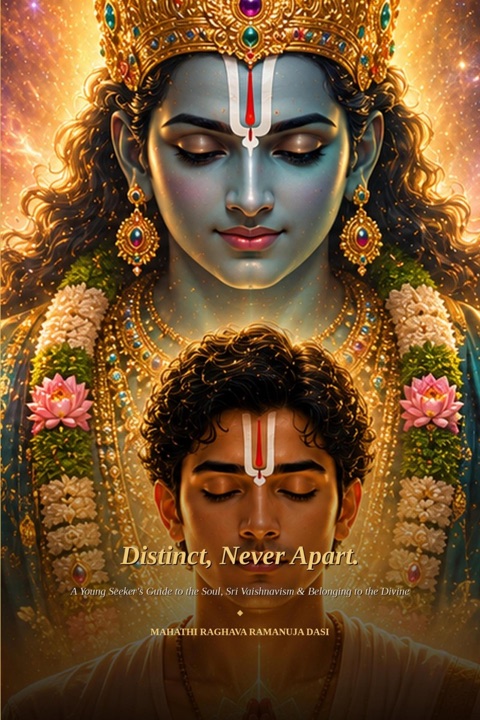
We’ve all needed that person — the one who vouches for you when the cold facts are stacked against you. In the world of the soul, that person has a name. Her name is Maha Lakshmi. … In our philosophy, Maha Lakshmi is the Puruṣakāra — literally, the one who recommends you. She is the bridge. You don’t have to somehow figure out how to reach the Lord on your own; she is already reaching toward you, ready to take your hand and walk you across. … You will never have to stand before the Divine alone. Before you even open your mouth, the Mother is already speaking for you.
Mahathi Raghava Ramanuja Dasi, Distinct, Never Apart. All three books are in eBook, paperback and hardcover on Amazon and Notion Press.